Tell us about the job
Takes about a minute. No obligation.
A contractor quoting a furnace installation in Clark County has to get the load calculation right before anything else on the job matters. Homes in Clark County, WA run heat about nine months a year, from October through June. A furnace that is undersized for this house cycles harder and more often through the heating season, and the burner and heat exchanger carry that extra load directly. Sloppy sizing in a county with this kind of runtime does not stay hidden long. A properly sized, well-installed unit distributes the work across those months without pushing any single component past its design range.
Existing ductwork is what a furnace installation turns on in Clark County. Half the homes in Clark County, Washington were built in 1993 or earlier (2020-2024 ACS 5-year). Ducts put in for an older system were sized and routed around that system's output, and a new furnace may run at pressures and volumes the original layout was never built to handle. A contractor will check the duct configuration before anything else, because a unit that is correctly matched to the house on paper can still underperform if the distribution side cannot carry it.
What a Furnace Installation Covers in Your Home
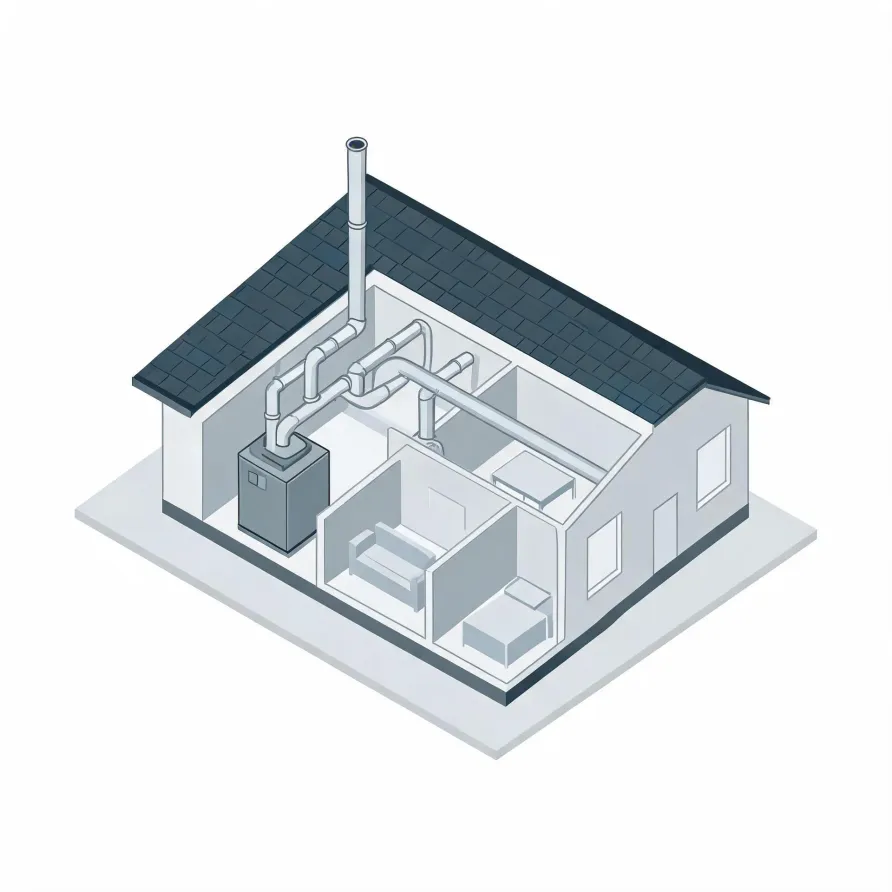
The furnace itself sits inside the house, most often in a basement, utility closet, or dedicated mechanical room. It is the central unit that produces heat, and it is where a contractor begins the installation. The flue or exhaust vent runs from the furnace out through the wall or roof, carrying combustion gases out of the living space.
The air handler or blower compartment, which may be part of the furnace cabinet or a separate unit, moves conditioned air into the duct system. The thermostat mounts on an interior wall and gives the household control over when the furnace runs. A contractor also connects the gas line and the condensate drain where the equipment requires them.
The drawing shows a typical layout, and a licensed contractor determines exactly what applies to your house and its existing setup.
Find a contractor in Clark CountyClark County, Washington, by the numbers
13 severe weather events were recorded in Clark County, Washington between 2015 and 2024.
NOAA National Centers for Environmental Information, Storm Events Database, bulk CSV export, events 2015-01-01 through 2024-12-31.Half the homes in Clark County, Washington were built in 1993 or earlier (2020-2024 ACS 5-year).
U.S. Census Bureau, 2020-2024 American Community Survey 5-Year EstimatesClark County, Washington holds 204,375 housing units (2020-2024 ACS 5-year).
U.S. Census Bureau, 2020-2024 American Community Survey 5-Year EstimatesOwners occupy 66.4% of the occupied homes in Clark County, Washington (2020-2024 ACS 5-year).
U.S. Census Bureau, 2020-2024 American Community Survey 5-Year EstimatesFurnace Installation Rules for Clark County, Washington5 codes, standards, and laws
What the installation looks like on your end
Non-weatherized gas furnaces manufactured on or after November 19, 2015 must reach 80.0 percent AFUE.
Non-weatherized oil-fired furnaces manufactured on or after November 19, 2015 must reach 83.0 percent AFUE.
Mobile home gas furnaces manufactured on or after November 19, 2015 must reach 80.0 percent AFUE.
Non-weatherized gas furnaces manufactured on or after December 18, 2028 must reach 95.0 percent AFUE, up from the 80.0 percent minimum that applies to units manufactured before that date.
Licensing and Legal Requirements in Clark County, Washington
Washington requires contractor registration rather than an HVAC licence: every contractor must register with the Department of Labor and Industries, and advertising, bidding or working as a contractor without that registration is a gross misdemeanour.