Tell us about the job
Takes about a minute. No obligation.
A furnace repair in Clark County starts with the parts that do the most work: the burner, the igniter, and the heat exchanger. Homes in Clark County, WA run heat about nine months a year, from October through June. Cycling on and off across that calendar wears the ignition system down gradually, and hairline cracks in heat exchangers develop from repeated thermal expansion rather than from any single failure. A contractor who skips a close inspection of the heat exchanger on a furnace with real seasons behind it is leaving the most likely fault undiagnosed.
Furnace repair in a house turns on what the opened unit actually contains, and in Clark County the spread is wide. Half the homes in Clark County, Washington were built in 1993 or earlier (2020-2024 ACS 5-year). A heat exchanger that has run hard through many wet winters may be cracked, or it may have years left. Burners and igniters from that era sit in different places on the parts availability map. A contractor who scopes a repair here has to open the unit and check each component against what can still be sourced, because two furnaces from the same period can land on opposite ends of the repair-or-replace question.
The Parts of a Furnace a Contractor Checks First
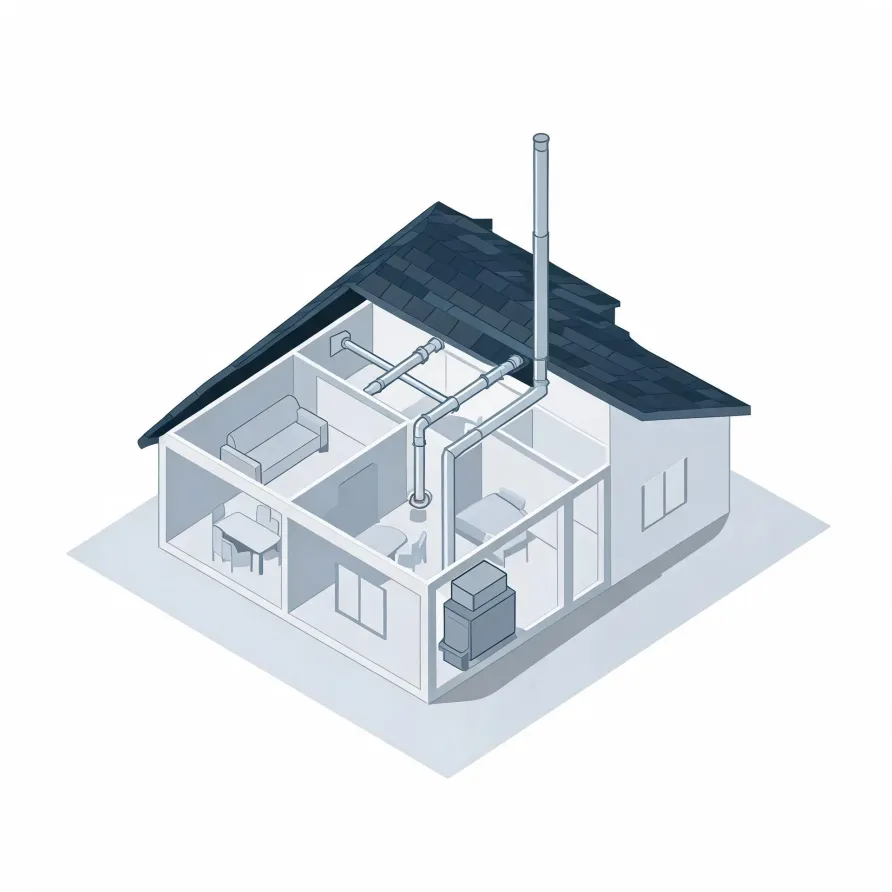
The furnace itself sits in a utility space, basement, or closet and is the piece that generates heat. Inside it, the heat exchanger is the part a contractor looks at closely during a repair call: cracks or corrosion there let combustion gases into the airstream, and a failed blower motor means the heat never leaves the cabinet at all.
The burners, igniter, and flame sensor sit inside the combustion chamber and work together to start and sustain a flame. When a furnace short-cycles, refuses to light, or throws an error code, those three parts are where a contractor typically begins. The flue and venting run from the cabinet to the outside and carry exhaust away from the living space.
The drawing shows a general layout of these components, and a licensed contractor determines what applies to your specific system and house.
Find a contractor in Clark CountyClark County, Washington, by the numbers
13 severe weather events were recorded in Clark County, Washington between 2015 and 2024.
NOAA National Centers for Environmental Information, Storm Events Database, bulk CSV export, events 2015-01-01 through 2024-12-31.Half the homes in Clark County, Washington were built in 1993 or earlier (2020-2024 ACS 5-year).
U.S. Census Bureau, 2020-2024 American Community Survey 5-Year EstimatesClark County, Washington holds 204,375 housing units (2020-2024 ACS 5-year).
U.S. Census Bureau, 2020-2024 American Community Survey 5-Year EstimatesOwners occupy 66.4% of the occupied homes in Clark County, Washington (2020-2024 ACS 5-year).
U.S. Census Bureau, 2020-2024 American Community Survey 5-Year EstimatesFurnace Repair Rules on the Books for Clark County, Washington5 codes, standards & laws
What happens when a contractor comes out for HVAC repair in Clark County
Non-weatherized gas furnaces manufactured on or after November 19, 2015 must reach 80.0 percent AFUE.
Non-weatherized oil-fired furnaces manufactured on or after November 19, 2015 must reach 83.0 percent AFUE.
Mobile home gas furnaces manufactured on or after November 19, 2015 must reach 80.0 percent AFUE.
Non-weatherized gas furnaces manufactured on or after December 18, 2028 must reach 95.0 percent AFUE, up from the 80.0 percent minimum that applies to units manufactured before that date.
What Clark County, Washington Requires for HVAC Repair
Washington requires contractor registration rather than an HVAC licence: every contractor must register with the Department of Labor and Industries, and advertising, bidding or working as a contractor without that registration is a gross misdemeanour.