Tell us about the job
Takes about a minute. No obligation.
A furnace contractor here starts with the heat exchanger and the burner assembly, because those are the parts that cycle on and off through the bulk of the year. Homes in Lewis County, WA run heat about ten months a year, from September through June. Ignition components, in particular, degrade against that kind of continuous seasonal demand, and a cracked heat exchanger or a worn igniter is a more common finding on a service call here than a failed control board or a wiring fault. The contractor checks the combustion side first, prices that repair, and works outward from there.
Furnaces in houses this old were installed into a market that has since been replaced twice over, and the parts those original or early-replacement units require are the variable that changes a repair bill most sharply. Half the homes in Lewis County, Washington were built in 1980 or earlier (2020-2024 ACS 5-year). That matters for repair work specifically because a contractor opening a furnace here has to confirm parts availability before a quote means anything. If the components the unit takes have gone out of production, the repair either jumps in scope or becomes a replacement conversation. The age of the house tells a contractor where to start looking; what they find inside the cabinet decides where the job actually goes.
The Parts of a Furnace a Contractor Checks First
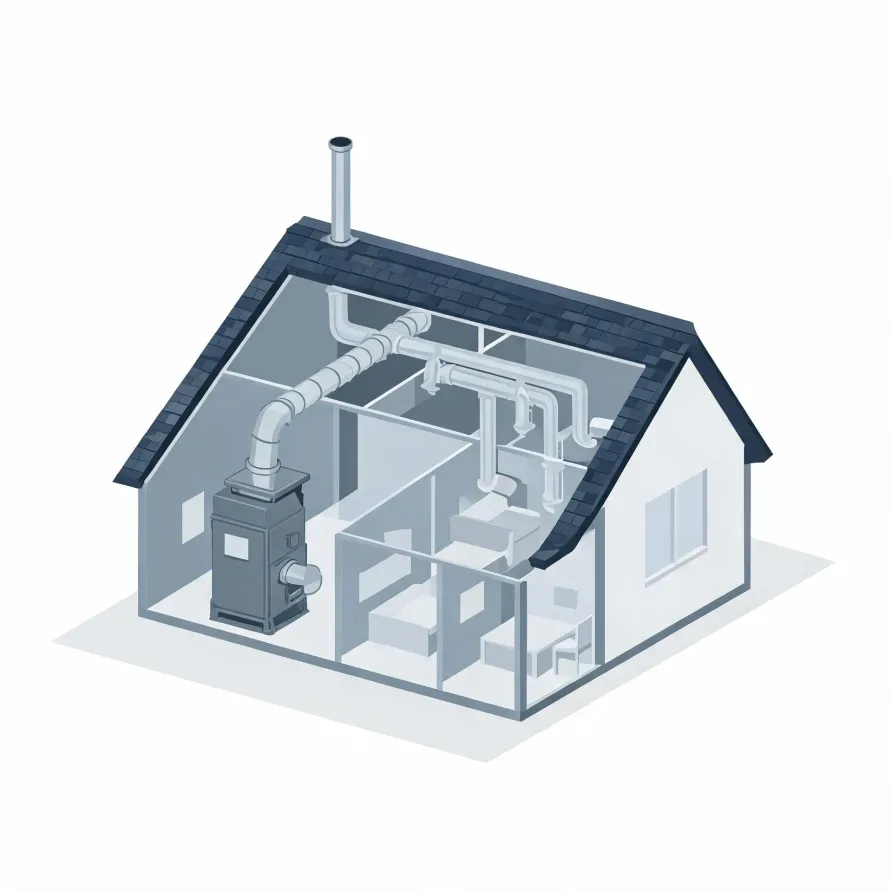
The furnace itself sits in the basement, utility room, or closet and is the piece a contractor opens first. Inside it, the heat exchanger does the work of warming air, and a cracked or corroded exchanger is one of the more serious faults a technician looks for. The burners, igniter, and flame sensor all sit inside that cabinet too, and any one of them can be the reason a furnace starts poorly, runs rough, or shuts off before the house reaches temperature.
The blower motor and its fan wheel sit at the base of the furnace and push conditioned air out through the supply side of the house. The flue pipe runs from the top or back of the furnace to the outside, carrying combustion gases out. A contractor checks both: a failing blower shows up as weak airflow, and a blocked or deteriorating flue is a safety concern that gets addressed before anything else.
The drawing shows the general layout of a furnace system, and a licensed contractor determines what applies to the specific equipment and configuration in your home.
Find a contractor in Lewis CountyLewis County, by the numbers
Half the homes in Lewis County, Washington were built in 1980 or earlier (2020-2024 ACS 5-year).
U.S. Census Bureau, 2020-2024 American Community Survey 5-Year EstimatesLewis County, Washington holds 36,512 housing units (2020-2024 ACS 5-year).
U.S. Census Bureau, 2020-2024 American Community Survey 5-Year EstimatesOwners occupy 75.8% of the occupied homes in Lewis County, Washington (2020-2024 ACS 5-year).
U.S. Census Bureau, 2020-2024 American Community Survey 5-Year EstimatesCodes & Standards Covering Furnace Repair in Lewis County, Washington5 sourced rules and standards
What happens when a contractor comes out for HVAC repair in Lewis County
Non-weatherized gas furnaces manufactured on or after November 19, 2015 must reach 80.0 percent AFUE.
Non-weatherized oil-fired furnaces manufactured on or after November 19, 2015 must reach 83.0 percent AFUE.
Mobile home gas furnaces manufactured on or after November 19, 2015 must reach 80.0 percent AFUE.
Non-weatherized gas furnaces manufactured on or after December 18, 2028 must reach 95.0 percent AFUE, up from the 80.0 percent minimum that applies to units manufactured before that date.
What Lewis County and Washington Require for HVAC Repair
Washington requires contractor registration rather than an HVAC licence: every contractor must register with the Department of Labor and Industries, and advertising, bidding or working as a contractor without that registration is a gross misdemeanour.