Tell us about the job
Takes about a minute. No obligation.
Sizing a furnace for Skagit County starts with understanding what the burner and heat exchanger are actually being asked to carry across a year. Homes in Skagit County, WA run heat about eleven months a year, from September through July. A furnace running that much of the calendar cycles its ignition system and heat exchanger far more than equipment in a shorter heating climate. Poorly sized equipment cannot hide that gap in idle months. A contractor working an installation here runs a load calculation that reflects the real season, then selects and commissions equipment rated to handle the cycling without accelerating wear on its core components.
Existing ductwork is what a furnace installation turns on in a county where the housing stock runs this old. Half the homes in Skagit County, Washington were built in 1986 or earlier (2020-2024 ACS 5-year). Duct systems put in during the original build were sized and laid out for the equipment of that era, and the furnaces running in those houses today are not the ones the ducts were designed around. A contractor scoping an installation has to check whether the existing supply and return paths will actually carry the new unit's airflow before any equipment selection makes sense. If the ductwork cannot, the job changes in scope and cost.
What a Furnace Installation Puts in Your Home
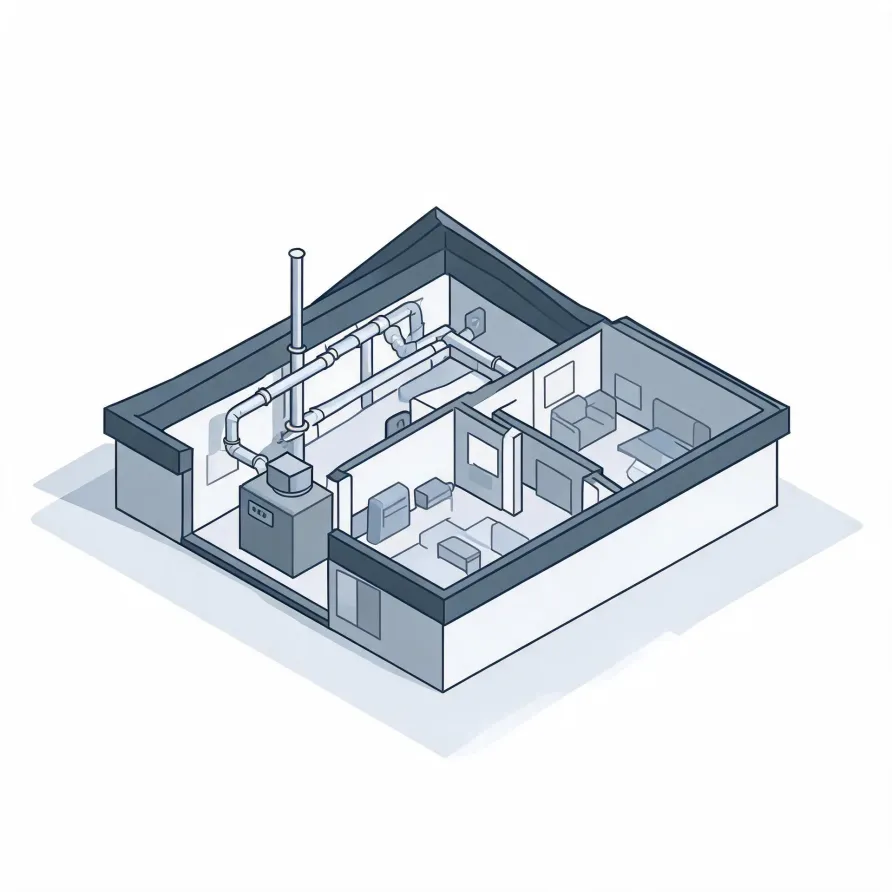
The furnace itself sits inside the house, most often in a basement, utility room, or closet. It is the system's heat source, drawing in air, warming it, and pushing it back out through the supply side of your ductwork. A flue pipe runs from the furnace to the exterior, carrying combustion gases out of the building.
The thermostat mounts on an interior wall and serves as the control point, telling the furnace when to fire and when to stop. A contractor also installs the filter housing where return air enters the system, and fits any venting components the equipment and local code require.
The drawing shows a typical layout, and a licensed contractor determines exactly what applies to your house and its existing setup.
Find a contractor in Skagit CountySkagit County, by the numbers
Half the homes in Skagit County, Washington were built in 1986 or earlier (2020-2024 ACS 5-year).
U.S. Census Bureau, 2020-2024 American Community Survey 5-Year EstimatesSkagit County, Washington holds 57,050 housing units (2020-2024 ACS 5-year).
U.S. Census Bureau, 2020-2024 American Community Survey 5-Year EstimatesOwners occupy 70.1% of the occupied homes in Skagit County, Washington (2020-2024 ACS 5-year).
U.S. Census Bureau, 2020-2024 American Community Survey 5-Year EstimatesFurnace Installation Rules on the Books for Skagit County, Washington5 codes, standards & laws
What the installation looks like
Non-weatherized gas furnaces manufactured on or after November 19, 2015 must reach 80.0 percent AFUE.
Non-weatherized oil-fired furnaces manufactured on or after November 19, 2015 must reach 83.0 percent AFUE.
Mobile home gas furnaces manufactured on or after November 19, 2015 must reach 80.0 percent AFUE.
Non-weatherized gas furnaces manufactured on or after December 18, 2028 must reach 95.0 percent AFUE, up from the 80.0 percent minimum that applies to units manufactured before that date.
Licensing and Legal Requirements in Skagit County, Washington
Washington requires contractor registration rather than an HVAC licence: every contractor must register with the Department of Labor and Industries, and advertising, bidding or working as a contractor without that registration is a gross misdemeanour.