Tell us about the job
Takes about a minute. No obligation.
A furnace repair call in Skagit County usually starts with a contractor working out what else has been running hard alongside the part that failed. Homes in Skagit County, WA run heat about eleven months a year, from September through July. The burner, the heat exchanger, and the ignition system cycle together through nearly the whole year, and wear on one rarely arrives without stress on the others. A contractor diagnosing a furnace here checks the heat exchanger for cracks before quoting anything else, because a breach there changes the scope of the job entirely.
Furnaces in houses that have changed hands and heating systems more than once carry their own record: cracked heat exchangers, worn burner assemblies, and ignition components from a product line a manufacturer discontinued years ago. Half the homes in Skagit County, Washington were built in 1986 or earlier (2020-2024 ACS 5-year). That kind of longevity in the housing stock means a contractor opening a furnace here often has to establish whether a replacement part still exists before a repair scope is even possible. If it does, the job goes one direction. If the part is no longer made, the homeowner is deciding something larger, and that answer comes from what is inside the unit, not from the house's permit date.
The Parts of a Furnace a Contractor Checks First
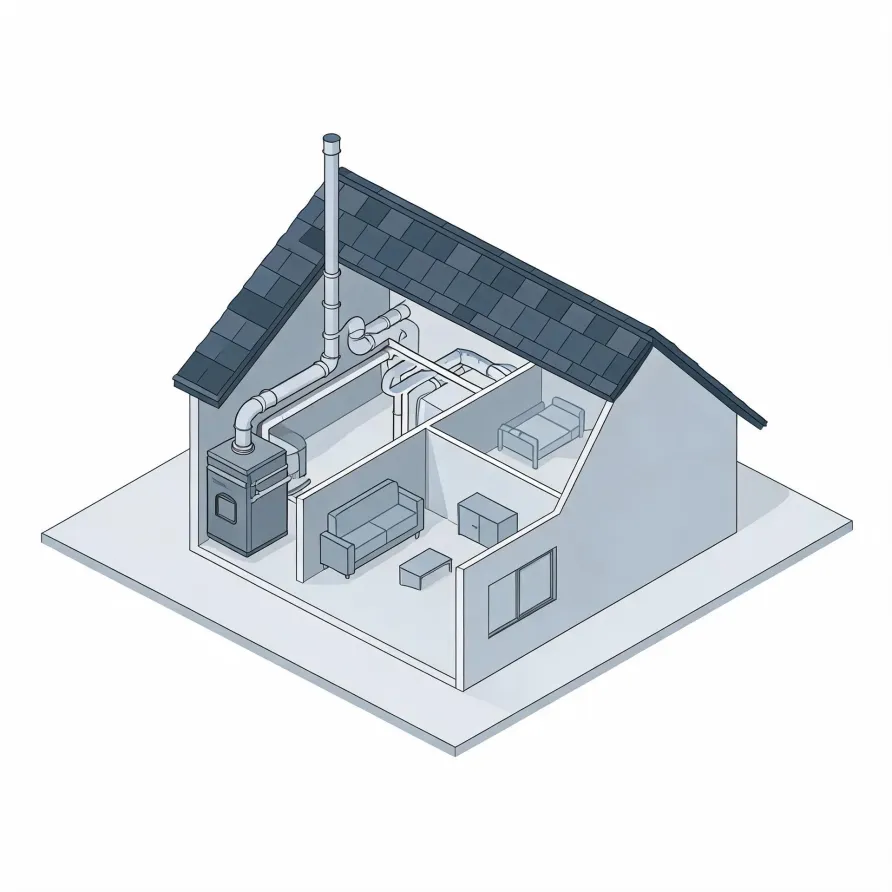
The furnace itself sits in the basement, utility room, or closet and is the piece most likely to be at the center of any problem. Inside it, the heat exchanger, burners, and blower motor each have a distinct job, and a fault in any one of them shows up differently. A cracked heat exchanger, a misfiring burner, and a failing blower motor all look like "furnace trouble" from the thermostat but point a contractor in different directions.
The flue pipe runs from the furnace up and out of the house, carrying combustion gases away, and a blockage or breach there can trigger a shutdown before anything else is touched. Alongside the furnace, the gas valve and the igniter are two small components a contractor checks early, because either one can stop a furnace cold while the rest of the system remains intact.
The drawing shows a general layout of a furnace system, and a licensed contractor determines which parts apply and what condition they are in for your specific home.
Find a contractor in Skagit CountySkagit County, by the numbers
Half the homes in Skagit County, Washington were built in 1986 or earlier (2020-2024 ACS 5-year).
U.S. Census Bureau, 2020-2024 American Community Survey 5-Year EstimatesSkagit County, Washington holds 57,050 housing units (2020-2024 ACS 5-year).
U.S. Census Bureau, 2020-2024 American Community Survey 5-Year EstimatesOwners occupy 70.1% of the occupied homes in Skagit County, Washington (2020-2024 ACS 5-year).
U.S. Census Bureau, 2020-2024 American Community Survey 5-Year EstimatesCodes & Standards Governing Furnace Repair in Skagit County, Washington5 sourced rules and standards
What the repair visit looks like
Non-weatherized gas furnaces manufactured on or after November 19, 2015 must reach 80.0 percent AFUE.
Non-weatherized oil-fired furnaces manufactured on or after November 19, 2015 must reach 83.0 percent AFUE.
Mobile home gas furnaces manufactured on or after November 19, 2015 must reach 80.0 percent AFUE.
Non-weatherized gas furnaces manufactured on or after December 18, 2028 must reach 95.0 percent AFUE, up from the 80.0 percent minimum that applies to units manufactured before that date.
What Skagit County, Washington Requires for HVAC Repair
Washington requires contractor registration rather than an HVAC licence: every contractor must register with the Department of Labor and Industries, and advertising, bidding or working as a contractor without that registration is a gross misdemeanour.