Tell us about the job
Takes about a minute. No obligation.
Sizing a furnace for a Garfield County home requires a contractor to work from actual local demand, not a regional average. Homes in Garfield County, WA run heat about ten months a year, from September through June. A burner and heat exchanger that cycle through that span accumulate wear that a poorly sized or sloppily installed system cannot absorb. An undersized furnace runs longer and harder each cycle, and the ignition system takes the brunt of that. A contractor quoting a replacement here has to get the load calculation right from the start, because the equipment has nowhere to hide a shortfall.
Ductwork laid out for heating equipment from another era does not always carry a modern furnace without modification. The runs may be the wrong size, the routing may not match where a new unit needs to draw and deliver air, and what looks like a straightforward swap can stall on what is already in the walls. Half the homes in Garfield County, Washington were built in 1957 or earlier (2020-2024 ACS 5-year). A contractor quoting a furnace installation has to assess that existing ductwork before the equipment choice settles anything, because the duct system is where the job's real variables live.
What a Furnace Installation Puts in Your Home
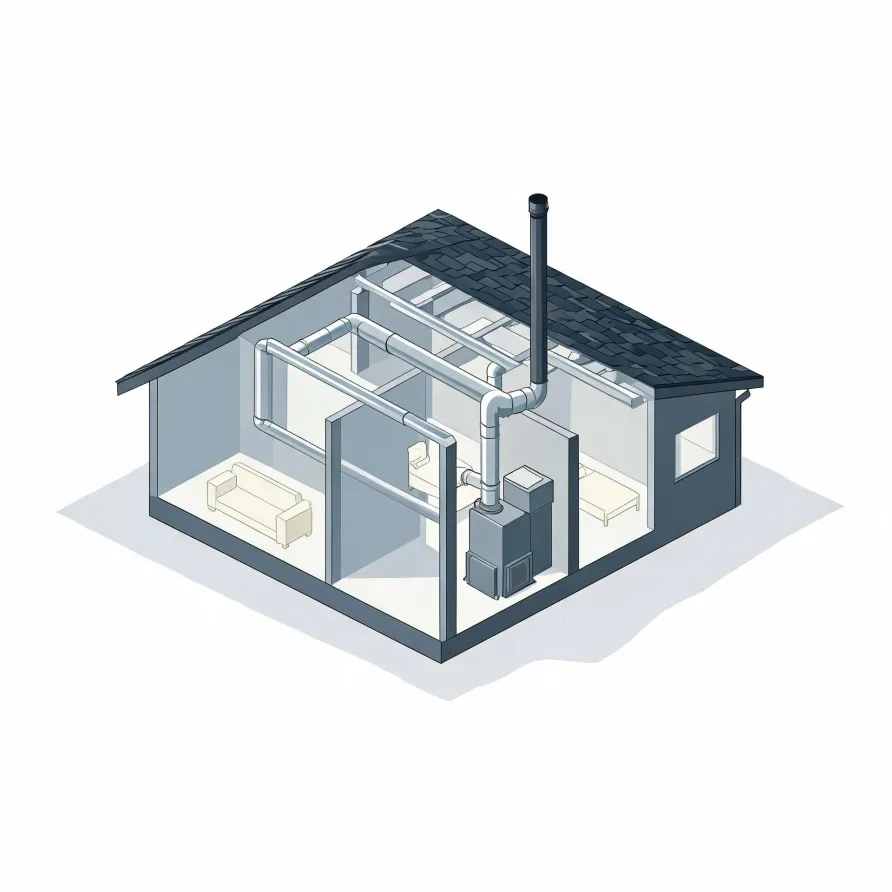
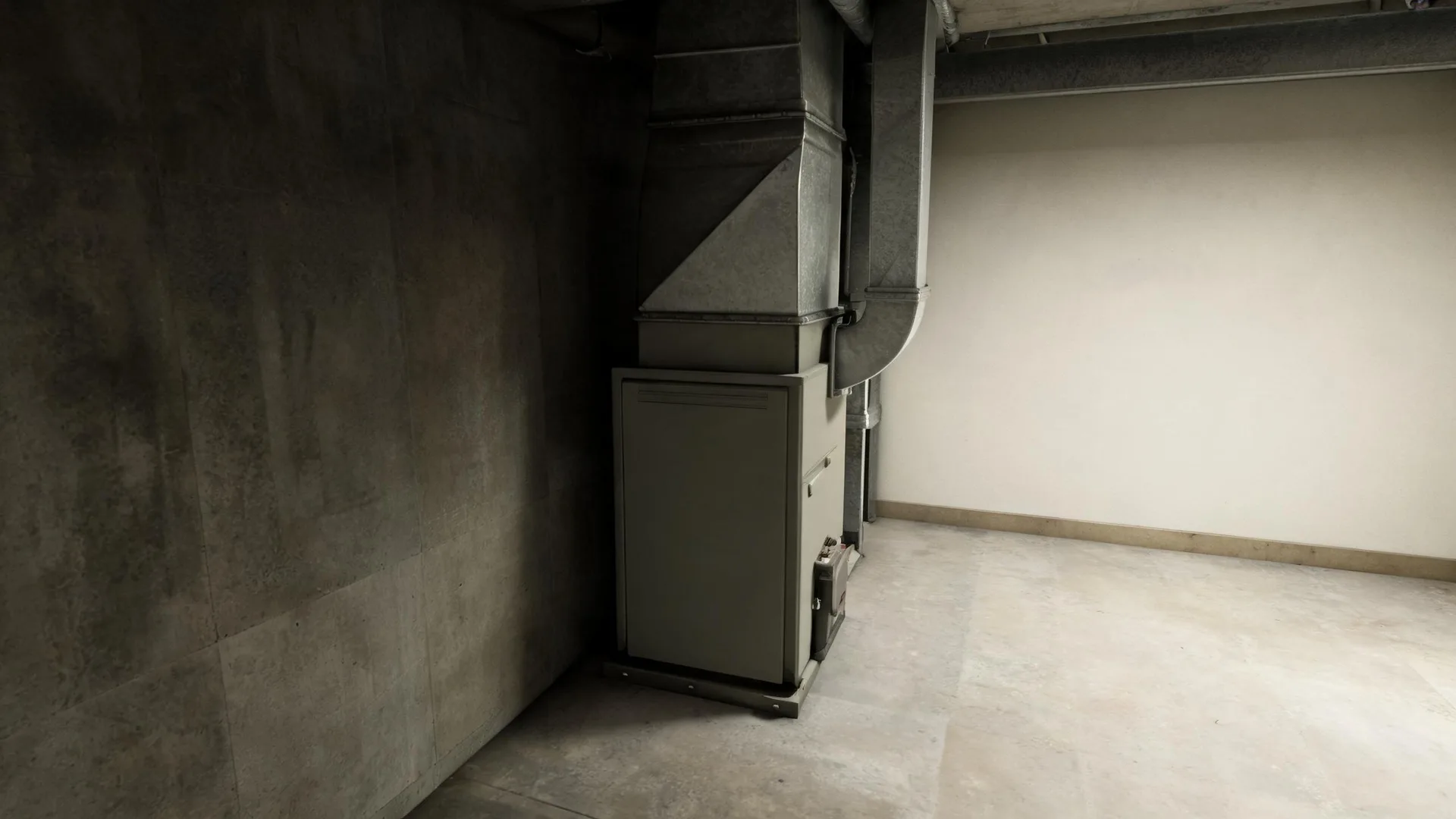
The furnace itself sits inside the house, most often in a basement, utility room, or closet. It holds the burner assembly, the heat exchanger, and the blower, all of which work together to produce and push conditioned air. A new installation means all of those components arrive as a unit and get set in place as one.
The flue pipe runs from the furnace to an exterior wall or roofline, carrying combustion gases out of the house. Alongside the furnace, a new thermostat goes on an interior wall and serves as the control point for the whole system. The condensate drain, where the equipment calls for one, runs to a floor drain or utility sink nearby.
The drawing shows a typical layout, and a licensed contractor determines what fits the specifics of your house.
Find a contractor in Garfield CountyGarfield County, Washington, by the numbers
48 severe weather events were recorded in Garfield County, Washington between 2015 and 2024.
NOAA National Centers for Environmental Information, Storm Events Database, bulk CSV export, events 2015-01-01 through 2024-12-31.Half the homes in Garfield County, Washington were built in 1957 or earlier (2020-2024 ACS 5-year).
U.S. Census Bureau, 2020-2024 American Community Survey 5-Year EstimatesGarfield County, Washington holds 1,221 housing units (2020-2024 ACS 5-year).
U.S. Census Bureau, 2020-2024 American Community Survey 5-Year EstimatesOwners occupy 76.9% of the occupied homes in Garfield County, Washington (2020-2024 ACS 5-year).
U.S. Census Bureau, 2020-2024 American Community Survey 5-Year EstimatesFurnace Installation Rules & Standards for Garfield County, Washington5 sourced rules and standards
What the installation looks like
Non-weatherized gas furnaces manufactured on or after November 19, 2015 must reach 80.0 percent AFUE.
Non-weatherized oil-fired furnaces manufactured on or after November 19, 2015 must reach 83.0 percent AFUE.
Mobile home gas furnaces manufactured on or after November 19, 2015 must reach 80.0 percent AFUE.
Non-weatherized gas furnaces manufactured on or after December 18, 2028 must reach 95.0 percent AFUE, up from the 80.0 percent minimum that applies to units manufactured before that date.
What Garfield County, Washington Requires for HVAC Installation
Washington requires contractor registration rather than an HVAC licence: every contractor must register with the Department of Labor and Industries, and advertising, bidding or working as a contractor without that registration is a gross misdemeanour.
Severe Weather History in Garfield County
Heating equipment in Garfield County works against whatever the climate puts on it, and that load shapes what a furnace needs to handle year after year. Sizing and installing equipment here is a local decision, and local weather is part of the reasoning.
48 severe weather events, 2015–2024. Source: NOAA National Centers for Environmental Information, Storm Events Database.