Tell us about the job
Takes about a minute. No obligation.
Sizing a furnace for this house takes more than measuring square footage. Homes in Columbia County, WA run heat about ten months a year, from September through June. The burner, heat exchanger, and ignition system run through almost no idle stretch, and a unit that is slightly undersized accumulates wear on those components faster than most installers quote for. A contractor doing the load calculation here has to account for the envelope, the ductwork, and the actual heat loss of the structure before committing to equipment capacity, because a furnace that cycles hard through that kind of season leaves the underpowered parts little time to hide the stress.
Ductwork sized for an older heating system does not automatically carry a modern furnace's output, and in Columbia County a large share of the housing was built around equipment that no longer exists in it. Half the homes in Columbia County, Washington were built in 1953 or earlier (2020-2024 ACS 5-year). That gap between the original build and what a contractor is now installing is where the job gets decided. A contractor has to assess whether the existing duct runs can handle the airflow a new furnace delivers, and whether the electrical service supports what the unit draws, before the equipment selection matters at all.
What a Furnace Installation Covers
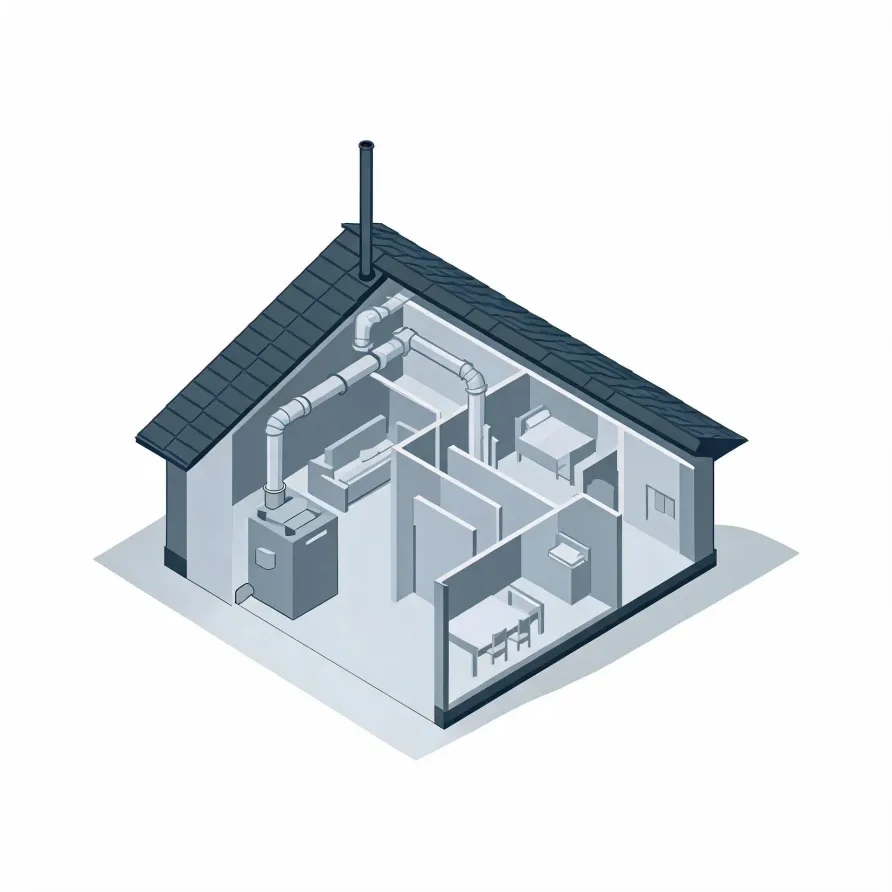
The furnace itself sits inside the house, most often in a basement, utility closet, or mechanical room. It is the unit a homeowner sees when they open that door: a metal cabinet that holds the burner assembly, the heat exchanger, and the blower. A flue pipe runs from the top or rear of the cabinet and exits through the wall or roof to carry combustion gases out.
The thermostat mounts on a wall in the living space and is the control point for the whole system. Alongside the furnace, a contractor also sets the filter housing if one is not already in place, and connects the supply and return air paths at the cabinet so conditioned air has a clear route through the house.
The drawing here shows a typical layout, and a licensed contractor determines exactly what applies to this house.
Find a contractor in Columbia CountyColumbia County, Washington, by the numbers
67 severe weather events were recorded in Columbia County, Washington between 2015 and 2024.
NOAA National Centers for Environmental Information, Storm Events Database, bulk CSV export, events 2015-01-01 through 2024-12-31.Half the homes in Columbia County, Washington were built in 1953 or earlier (2020-2024 ACS 5-year).
U.S. Census Bureau, 2020-2024 American Community Survey 5-Year EstimatesColumbia County, Washington holds 2,217 housing units (2020-2024 ACS 5-year).
U.S. Census Bureau, 2020-2024 American Community Survey 5-Year EstimatesOwners occupy 77.7% of the occupied homes in Columbia County, Washington (2020-2024 ACS 5-year).
U.S. Census Bureau, 2020-2024 American Community Survey 5-Year EstimatesFurnace Installation Rules for Columbia County, Washington5 codes, standards & laws
What the installation actually looks like
Non-weatherized gas furnaces manufactured on or after November 19, 2015 must reach 80.0 percent AFUE.
Non-weatherized oil-fired furnaces manufactured on or after November 19, 2015 must reach 83.0 percent AFUE.
Mobile home gas furnaces manufactured on or after November 19, 2015 must reach 80.0 percent AFUE.
Non-weatherized gas furnaces manufactured on or after December 18, 2028 must reach 95.0 percent AFUE, up from the 80.0 percent minimum that applies to units manufactured before that date.
Licensing and Legal Requirements in Columbia County, Washington
Washington requires contractor registration rather than an HVAC licence: every contractor must register with the Department of Labor and Industries, and advertising, bidding or working as a contractor without that registration is a gross misdemeanour.
Severe Weather in Columbia County
Heating equipment in Columbia County works against whatever the local climate demands of it. How hard a furnace runs over its lifetime is a local question, and the weather record here is part of the answer.
67 severe weather events, 2015–2024. Source: NOAA National Centers for Environmental Information, Storm Events Database.