Tell us about the job
Takes about a minute. No obligation.
A furnace repair here starts with what the burner and heat exchanger have already been through. Homes in Okanogan County, WA run heat about ten months a year, from September through June. Parts that cycle continuously through that kind of load develop cracks, scaling, and ignition failures at a pace a lightly used system does not. A contractor working a repair in Okanogan County checks the heat exchanger carefully before quoting anything else, because a cracked exchanger changes the scope of the job entirely.
Furnaces running in houses built for an earlier generation of equipment carry parts that are increasingly hard to source. Half the homes in Okanogan County, Washington were built in 1982 or earlier (2020-2024 ACS 5-year). When a contractor opens a furnace here, what they find in the heat exchanger and burner assembly decides how the repair goes: whether the part it needs still has a supply chain behind it, or whether the job becomes a conversation about what is actually available. That gap between what a system takes and what distributors still stock is where many repairs in this county get complicated.
The Parts of a Furnace a Contractor Checks First
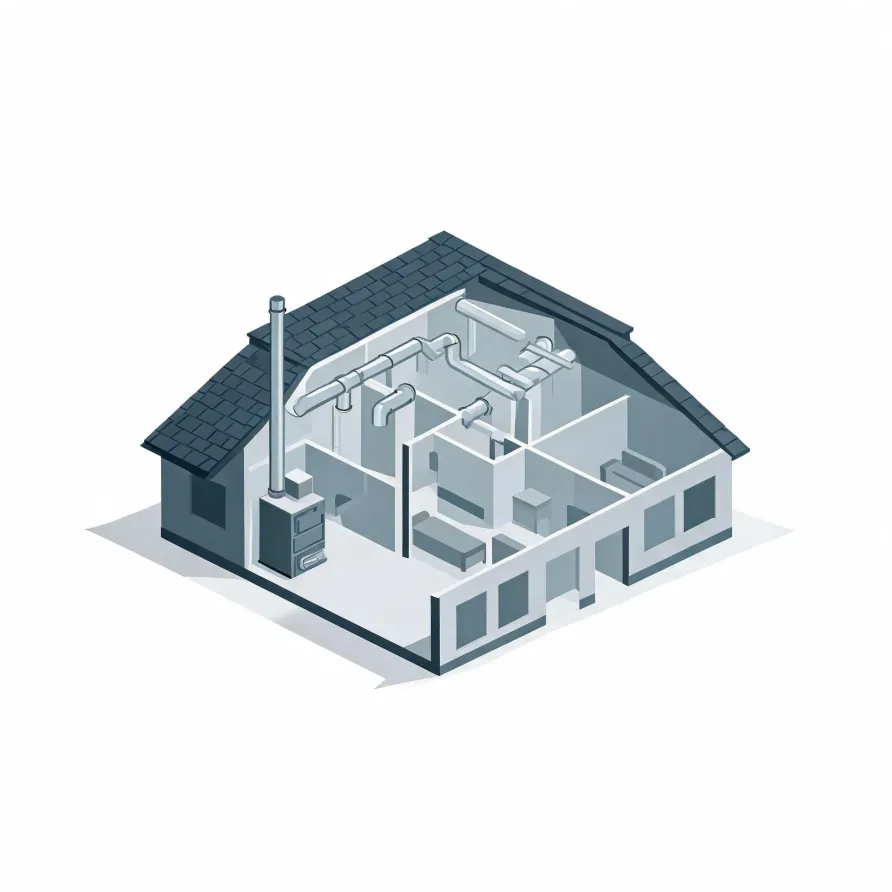
The furnace itself sits in a utility room, basement, or closet and is the piece a contractor goes to first. Inside it, the heat exchanger, burners, and blower motor each have a distinct job, and a failure in any one of them shows up differently. A cracked heat exchanger, a dirty burner, or a worn blower motor each produces its own set of symptoms.
The flue pipe runs from the furnace out through the wall or roof and carries combustion gases out of the house. Alongside it, the thermostat on the wall and the limit switches and control board inside the cabinet are what tell the furnace when to fire and when to stop. When a contractor diagnoses a no-heat call, these controls are often where the answer sits.
The drawing shows a general layout of the system, and a licensed contractor determines which components apply and what condition they are in for your specific home.
Find a contractor in Okanogan CountyOkanogan County by the numbers
286 severe weather events were recorded in Okanogan County, Washington between 2015 and 2024.
NOAA National Centers for Environmental Information, Storm Events Database, bulk CSV export, events 2015-01-01 through 2024-12-31.Half the homes in Okanogan County, Washington were built in 1982 or earlier (2020-2024 ACS 5-year).
U.S. Census Bureau, 2020-2024 American Community Survey 5-Year EstimatesOkanogan County, Washington holds 22,156 housing units (2020-2024 ACS 5-year).
U.S. Census Bureau, 2020-2024 American Community Survey 5-Year EstimatesOwners occupy 72.4% of the occupied homes in Okanogan County, Washington (2020-2024 ACS 5-year).
U.S. Census Bureau, 2020-2024 American Community Survey 5-Year EstimatesFurnace Repair Rules on Record for Okanogan County, Washington5 codes, standards & laws
What the repair visit looks like
Non-weatherized gas furnaces manufactured on or after November 19, 2015 must reach 80.0 percent AFUE.
Non-weatherized oil-fired furnaces manufactured on or after November 19, 2015 must reach 83.0 percent AFUE.
Mobile home gas furnaces manufactured on or after November 19, 2015 must reach 80.0 percent AFUE.
Non-weatherized gas furnaces manufactured on or after December 18, 2028 must reach 95.0 percent AFUE, up from the 80.0 percent minimum that applies to units manufactured before that date.
Licensing Rules for HVAC Repair in Okanogan County, Washington
Washington requires contractor registration rather than an HVAC licence: every contractor must register with the Department of Labor and Industries, and advertising, bidding or working as a contractor without that registration is a gross misdemeanour.
Severe Weather Events in Okanogan County
Extreme weather puts real strain on furnace systems, and how hard a unit works over its life is largely a function of local conditions. Repair needs in Okanogan County are shaped by what the weather here actually does to equipment, which is why that record belongs on this page.
286 severe weather events, 2015–2024. Source: NOAA National Centers for Environmental Information, Storm Events Database.